Why Choice Matters in Narrative Games
Island of Lost Things, 2025
It is certain that, one day, we all will die.
But what if we could choose when that moment comes?
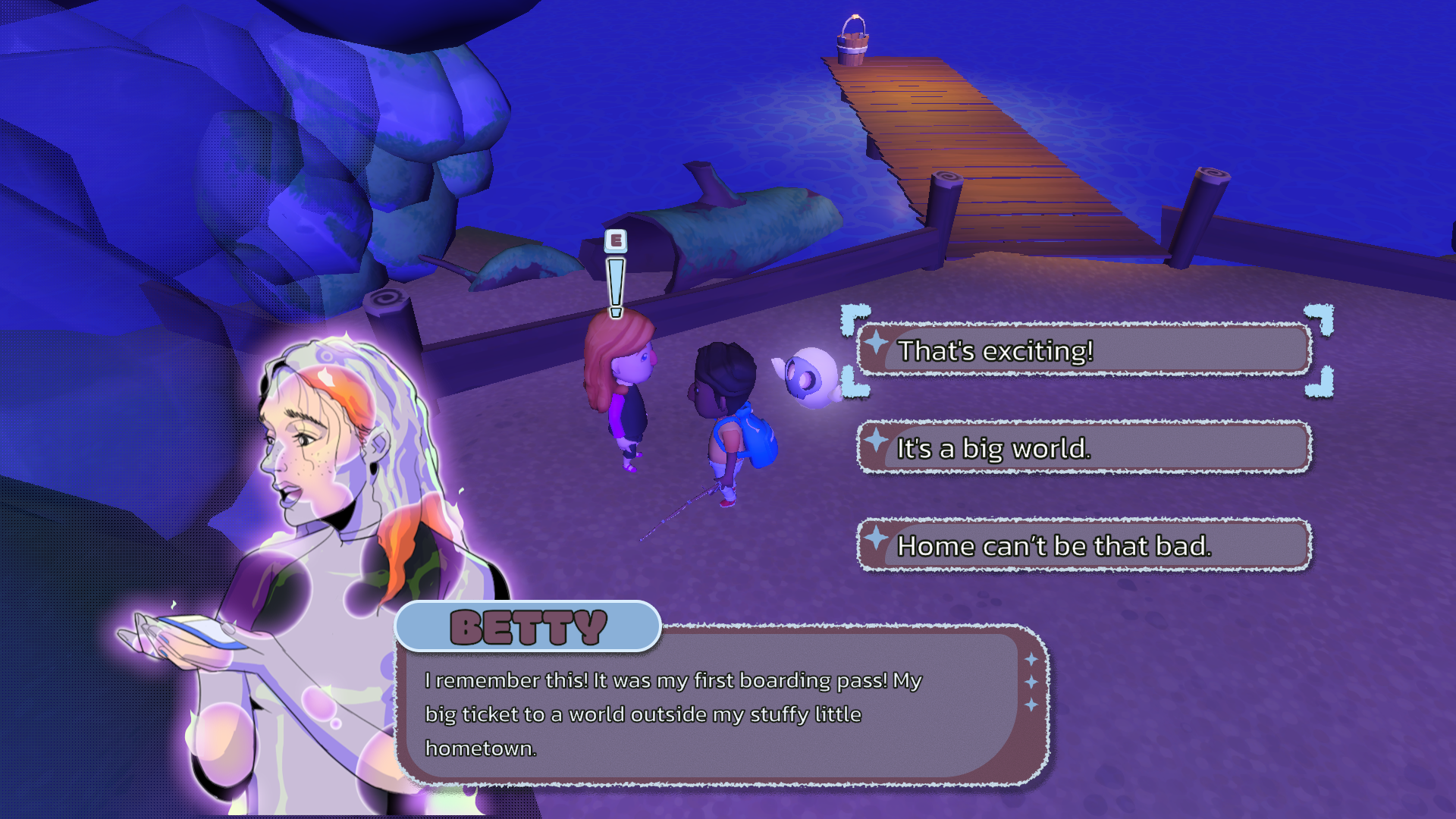
Island of Lost Things is a cozy exploration game that explores this choice, and I had the privilege of writing it. In the game, you play as a spirit medium, who arrives on a strange island. On this island, are the spirits of three long-term coma patients, who are neither able to wake up nor pass on. By finding lost items that hold important memories and sharing them with each spirit, you can empower them to find the strength to wake up from their comas or accept that their life has come to an end.
Why Choice Matters
I was first introduced to player choice through computer role playing games (RPGs)—games with world building as deep as a novel. Unlike most novels though, RPGs had an interactive element that positioned me, as a player, to be an active participant in that world.
And this is why choice is so important. It deepens immersion and builds player agency by creating a world that responds to character interactions in meaningful ways. Each click of the mouse is a nudge on the pencil that details the narrative. When I, as a player, interact with each non-playable character (NPC), I am working in tandem with the game’s creator to decide how the story will go.
Island of Lost Things explores the impact of meaningful conversations with vulnerable people, the choices we make, and the empathy we extend. It was imperative to me that the player has an impact on the game’s story.
How Choices Are Created
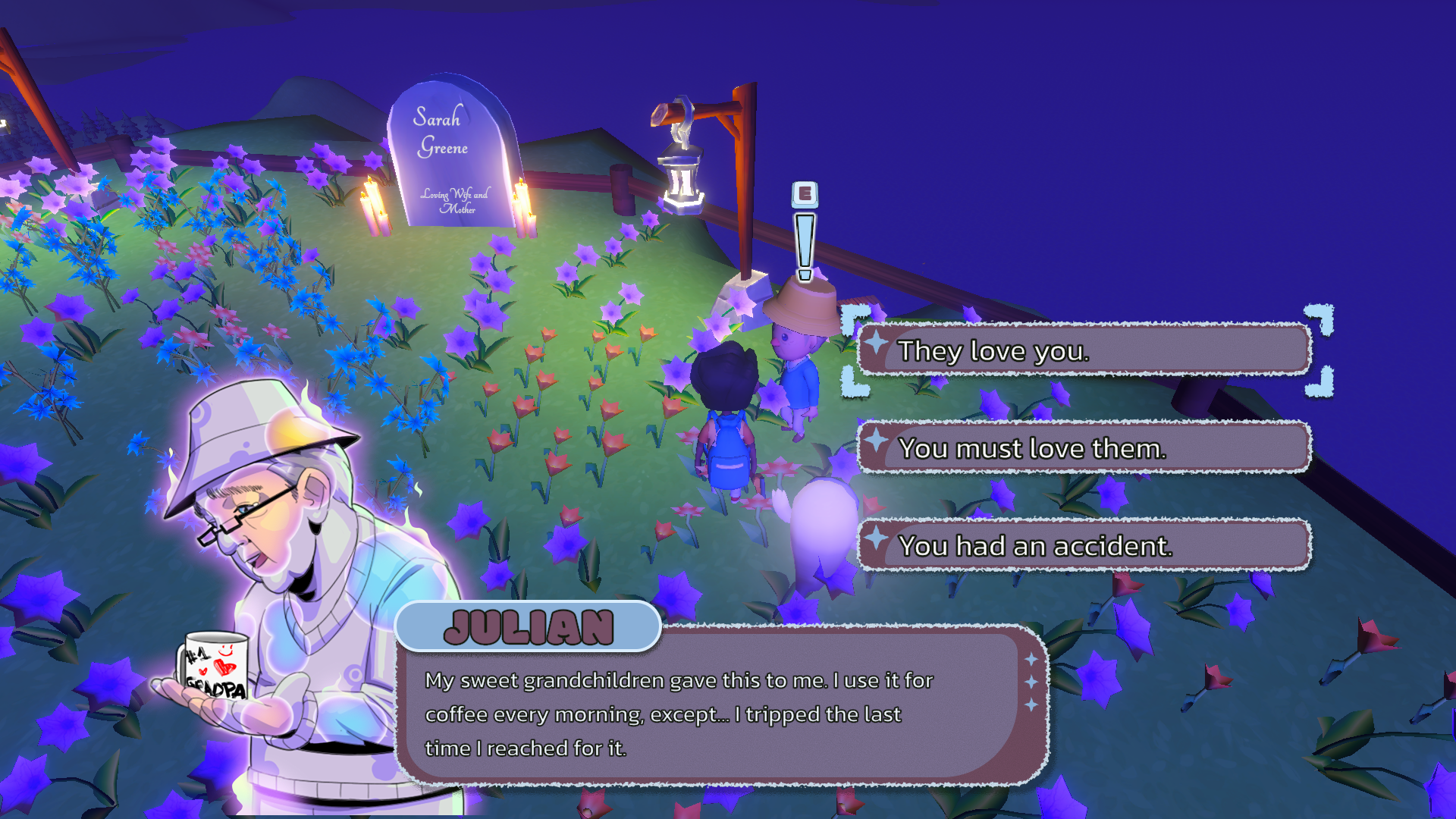
To those unfamiliar with video games, “deciding how the story will go” is frequently done through something called branching dialogue. In real life, our interactions start with a statement or a question then might divert in a million different ways, depending on how we as people respond. When crafting the branching dialogue for Island of Lost Things, I had to determine how I wanted the player to be able to engage with and ultimately influence the story. This led me to two outcomes, which are available in the game: (1) the ability to influence a spirit to return to life, or (2) the ability to influence them to let go.
However, there will always be three choices the player can choose from when interacting with an NPC. That third path is inspired by those wanting to take a neutral approach.
But who would want to take a neutral approach?
Well… me.
Island of Lost Things, 2025
Inaction is Still a Choice
When I first started playing narratively rich games with multiple choices, I was nervous that I might make the “wrong” choice. Now, I know I could always replay the game or savescum if I didn't like the outcome, but that wasn't why I played. I wanted to tell a story.
There are so many games that immediately come to mind when I think of games with strong player influence: Baldurs Gate 3, which I mentioned in my game developers conference post, Life is Strange, and the Pathfinder series produced by Owlcat are some that have completely blown me out of the water, but my absolute favorite, and the inspiration for my neutral path, was Pillars of Eternity.
Within the first 15 minutes of Pillars of Eternity, the player is introduced with a choice: to sacrifice their weapon to save an NPC who is being chased by enemies, utilize a skill to otherwise help the NPC, or the player could simply hope the NPC could take care of himself. In other words, the player could take the neutral path—the path of inaction—not putting themselves at risk in exchange for not intervening. In real life, we call this being a bystander, and what Pillars of Eternity does incredibly well in this opening moment is establish that being a bystander is a viable option. The game also establishes that—like in real life—there are still consequences for inaction. Spoiler: the player’s character will keep their weapon, and the NPC dies.
How Choices Are Weighted
In Island of Lost Things, every dialogue choice contributes to one of the two outcomes. Players may choose a more neutral path, picking dialogue choices that are less-opinionated; or they may try to choose words that push the character toward a preferred outcome. If players choose the former, they are defaulting to the predisposition of the trapped spirit.
Every trapped spirit has an internal predisposition related to their outcome. Some may be more comfortable with the idea of returning to life than others. As you uncover their stories, you might recognize what those predispositions are. This was essential to include in the dialogue options because it made the characters feel real. In life, the people we encounter have their own thoughts, beliefs, and attachments, which influence their behavior. Yet, meaningful conversations at vulnerable moments might change a life. And there is no greater vulnerable moment than the pausing of time, one step away from death. If the player is willing to take an active, non-neutral path, they are capable of changing an NPC’s mind.
In the backend, the script looks something like this (mild spoilers):

Island of Lost Things Script, 2025
Each choice is weighted, meaning that a tiny line of code informs a formula that ultimately determines if the NPC returns to life or not. If the player continually chooses dialogue interactions weighted with waking up, the NPC will decide to return to life. Alternatively, if the player continually chooses dialogue interactions weighted with passing on, the NPC will decide that it's time for them to make peace with the life they lived and move on to whatever comes next.
In my eyes, there are no wrong choices. There are reasons for each NPC to experience either outcome. To me, the emphasis is not on the outcome of choice, but the power of choice. How we choose to prioritize empathy or hard logic in vulnerable moments; how we choose to focus on hopes or regrets at the cusp of change. The outcome is the benefit of the journey. It is the evidence that our choices always mattered.
Island of Lost Things is available to play for free right now on Steam. Check out more of my game writing here.