Origin Stories: In A Pickle
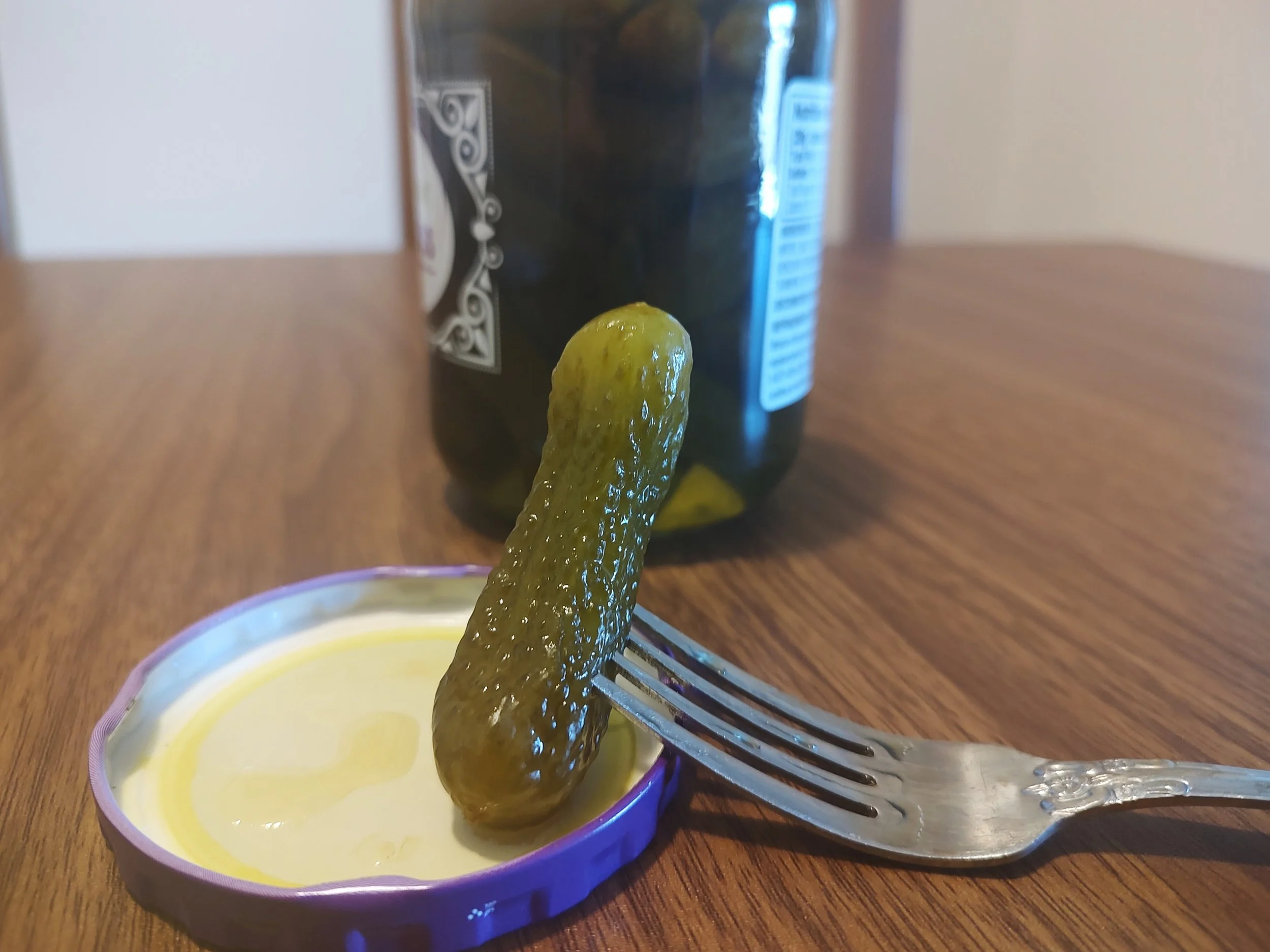
I’ve been in the mood to eat pickles lately. Maybe it’s a sign of how ready I am for the warming weather. To me, pickles are the perfect summer snack, associated with barbecues and club sandwiches. I enjoy eating a pickle, but I don’t enjoy being in one, which brings me to the topic of this week’s Origin Stories. For all the times I’ve been in a difficult situation, why do I think to say that I’m in a pickle?
The first appearance of the word “pickle” in the English language is debated, but likely sometime in the 1300s or 1400s. It is believed to come from the Dutch word “pekel,” which refers to brine or the act of brining. Some linguists suggest that “pekel” may share the same root word as “peken,” meaning to prick or pierce. The suffix -el, modifies the word to mean “something that pricks.” While eating a pickle may be a difficult or painful experience for someone with a sore, the definition is a bit of a leap to understanding our modern day idiom.
From early documentation and understanding, the word pickle frequently comes in the context of food. Not until 1562, do we see the word exist in new contexts. The phrase “Freilties pickell” appears in page 157 of John Heywood’s Proverbs and Epigrams with ambiguity. In 1585, Protestant clergyman and historian John Foxe wrote: “In this pickle lyeth man by nature, that is, all wee that be Adams children.” In 1610, William Shakespeare clarified his use of the idiom in his play The Tempest. King Alonso notices about his jester: “Trinculo is reeling ripe. Where should they find this grand liquor that hath gilded ’em?” He then asks, “How came’st thou in this pickle?” Clearly, “in this pickle” refers to being drunk, which is reinforced throughout the script.
Yet, this definition seems to be unique to Shakespeare, or at least, in specific regards to alcohol. The next written account in 1660 comes from the diaries of Samuel Pepys, who writes, “at home with the workmen all the afternoon, our house being in the most sad pickle.” Unless I’m missing something and houses can become intoxicated, Pepys’ use of the idiom suggests a slightly different meaning that is closer to how we might understand it today. Being in a pickle means being in a mess, which, admittedly, is the case of many drunks.
The clearest evidence of this, and perhaps the best for understanding the true meaning of this phrase, comes back to the context of food. In America, the word “pickle” holds a different meaning than it does in the United Kingdom. In America, a pickle refers to a briny cucumber, but in the UK that would be known as a gherkin. In the UK, pickle refers to a condiment made from vinegar, spices, and a mishmash of vegetables, which is often called “relish” back in the states. So all this time I’ve been imagining myself in a singular pickle, I’ve really been referring to my circumstances as a jumbled up mess of them.